

Earth, Life Evolution, and the Universe
Subject: Science and Technology

Overview
Earth formed 4.6 billion years ago and its history spans from the Precambrian to the Cenozoic. Life evolved from single cells to complex organisms over billions of years. The universe began with the Big Bang and contains billions of galaxies. Our Solar System has 8 planets orbiting the Sun.
The Formation of Earth
Earth formed approximately 4.6 billion years ago from a cloud of gas and dust in space (the solar nebula). Gravity pulled material together, forming a hot, molten mass that gradually cooled. The outer surface solidified to form the crust, while denser materials (iron and nickel) sank to form the core. Earth's atmosphere and oceans developed from volcanic gases and water brought by comets and asteroids.
[Image: Cross-section of Earth showing layers: inner core (solid iron-nickel), outer core (liquid iron), mantle (silicate rock), and thin crust]
Geological Time and Life Evolution
Earth's 4.6-billion-year history is divided into major time units called geological eons, eras, and periods. Life on Earth has evolved dramatically over this time, from simple single-celled bacteria (3.8 billion years ago) to complex multicellular organisms.
| Era | Approximate Time | Major Life Forms |
|---|---|---|
| Precambrian | 4,600-541 million years ago | Bacteria, algae, simple multicellular organisms |
| Palaeozoic | 541-252 million years ago | Fish, amphibians, reptiles, ferns, and early seed plants |
| Mesozoic | 252-66 million years ago | Dinosaurs, early mammals, flowering plants |
| Cenozoic | 66 million years ago to present | Mammals diversify; primates appear; humans emerge |
The Universe and the Solar System
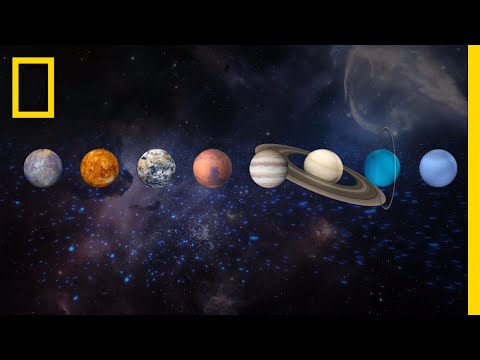
The universe is everything that exists: all matter, energy, space, and time. It is approximately 13.8 billion years old and began with the Big Bang. The universe contains billions of galaxies; the Milky Way is one galaxy containing our Solar System. The Solar System consists of the Sun (a star) and eight planets, along with moons, asteroids, and comets.
[Image: Solar system diagram showing Sun and eight planets: Mercury, Venus, Earth, Mars (inner rocky planets), Jupiter, Saturn, Uranus, Neptune (outer gas giants), with asteroid belt between Mars and Jupiter]
The Solar System
| Planet | Type | Notable Feature |
|---|---|---|
| Mercury | Rocky (terrestrial) | Closest to Sun; no atmosphere; extreme temperature range |
| Venus | Rocky (terrestrial) | Hottest planet; thick CO2 atmosphere; rotates backward |
| Earth | Rocky (terrestrial) | Only known planet with life; liquid water on surface |
| Mars | Rocky (terrestrial) | Red planet; thin atmosphere; highest volcano (Olympus Mons) |
| Jupiter | Gas giant | Largest planet; Great Red Spot storm; 95 known moons |
| Saturn | Gas giant | Spectacular ring system; least dense planet |
| Uranus | Ice giant | Rotates on its side; very cold |
| Neptune | Ice giant | Farthest planet; strongest winds in Solar System |
Stars and Galaxies
A star is a massive ball of plasma that generates energy through nuclear fusion in its core. Our Sun is a medium-sized star. Stars form in nebulae (clouds of gas and dust) and have life cycles: they begin as protostars, become main sequence stars, and end as red giants, then white dwarfs, neutron stars, or black holes depending on their mass.
Things to remember title
- Earth formed about 4.6 billion years ago from a cloud of gas and dust.
- Earth's geological history is divided into eons and eras; life has evolved from bacteria to complex organisms.
- The universe began with the Big Bang 13.8 billion years ago and contains billions of galaxies.
- The Solar System has 8 planets orbiting the Sun; the inner 4 are rocky, the outer 4 are gas or ice giants.
- Stars generate energy through nuclear fusion and go through a life cycle from protostar to stellar remnant.
© 2021 Saralmind. All Rights Reserved.
 Login with google