



Every exam season looks the same. A student sits with a thick textbook, starts at page one, and reads until they are tired. Two weeks later they have covered a lot of pages and still do not know which topics they would fail.
Re-reading feels like studying. It is not the same as knowing. The students who do well in school exams and in the SEE do something different: they find their weak topics early and spend their time there.
Here is a simple method you can start tonight.
Step 1: Test first, read second
Before you open the notes, try ten questions on the topic. Do not look anything up. Whatever you get wrong is where your time should go. Whatever you get right, you can leave alone.
Most students do this backwards. They read for an hour, then test themselves once, the night before the exam.
Step 2: Learn the reason, not just the answer
Getting a question right by luck teaches nothing. Getting it wrong and seeing why the right answer is right teaches a lot. When you check an answer, read the explanation every time, even for the questions you got correct.
Step 3: Keep a revision list, and let it shrink
Write down the topics you are weak in. Each time you improve, cross one off. A list that gets shorter is the best motivation a student can have, and for a parent it is proof that the effort is working.
Step 4: Revise in your own language
If a concept does not click in English, read it in Nepali, then go back to the English term. Understanding comes first, and the exam words can follow. Switching between both is not cheating. It is how many students finally understand a topic.
Step 5: Do a little every night
Thirty focused minutes on one weak topic beats a three hour panic the night before. Small, regular revision is what stays in memory.
Where Learn Yeti fits in
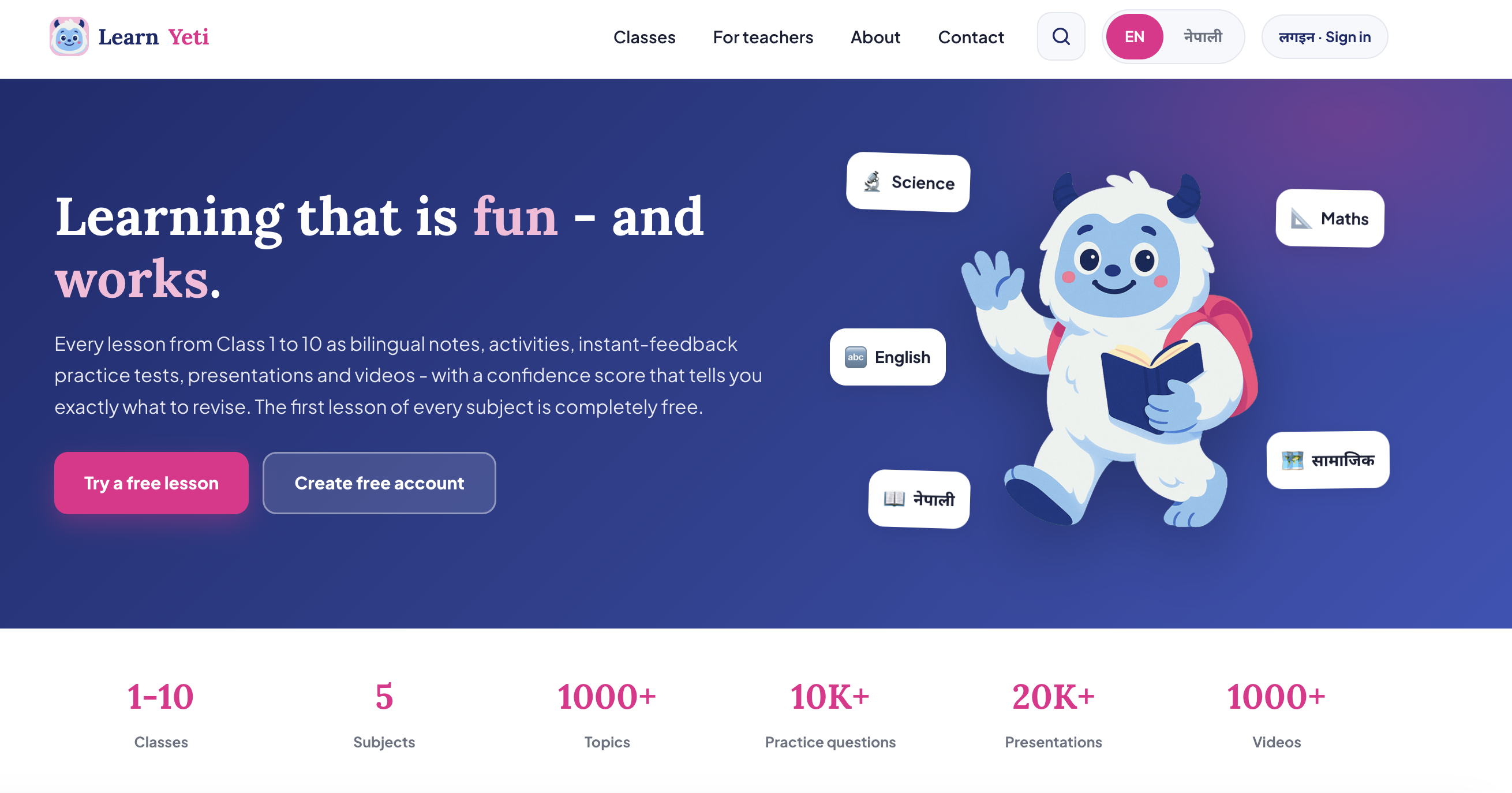
We built Learn Yeti for exactly this kind of revision. It covers Classes 1 to 10 with notes in both English and Nepali, practice tests that give instant feedback with the reason behind each answer, slides, and videos. A confidence score shows a student which topics to revise next, so nobody has to guess.
Early access is free for the first 1,000 users, until the end of this academic session. Join now, try it tonight, and see how it feels.
Claim your free early access at learnyeti.com
For parents
You do not need to understand Science or Maths to help. Ask one question each evening: "Which topic is on your list tonight?" If the list is getting shorter week by week, your child is on track.
For teachers
Ready slides and ready questions in both languages mean less time preparing and more time teaching. See what is available at learnyeti.com.
Learn smarter at learnyeti.com.

 Login with google