

Kingdom Fungi
Subject: Science and Technology

Overview
Fungi are eukaryotic organisms with chitin cell walls that obtain nutrition by absorbing organic matter rather than photosynthesising. Learn the characteristics of Kingdom Fungi, the three types of fungal nutrition (saprotrophic, parasitic, and symbiotic), and study examples including mushroom, yeast, Penicillium, and Rhizopus.
1. Introduction to Kingdom Fungi
Kingdom Fungi includes a diverse group of eukaryotic organisms that are neither plants nor animals. Fungi were once classified with plants because they are mostly non-motile and have a cell wall. However, they differ fundamentally from plants in that they cannot photosynthesise. Instead they obtain nutrients by absorbing organic matter from their surroundings through secreted enzymes.
Key Definition: Fungi are eukaryotic, mostly multicellular organisms with a chitin cell wall. They are absorptive heterotrophs. They secrete digestive enzymes outside their body and absorb the digested nutrients back in.
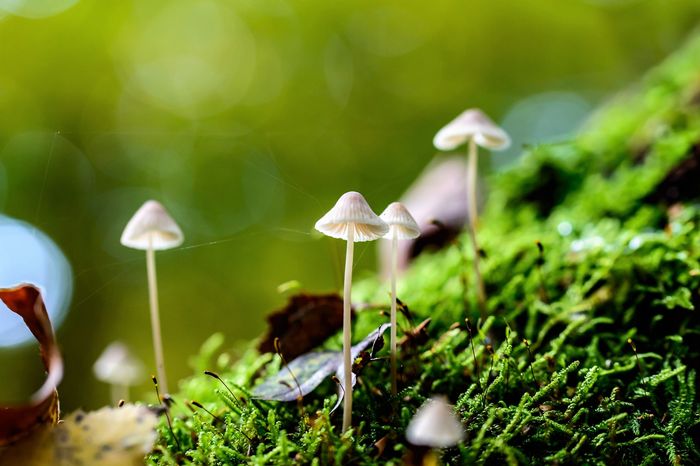
Mushrooms growing on a mossy surface. They are saprotrophic fungi that obtain nutrition by breaking down dead organic matter in their surroundings.
2. Characteristics of Kingdom Fungi
| Characteristic | Description |
|---|---|
| Cell type | Eukaryotic — membrane-bound nucleus present |
| Organisation | Mostly multicellular; yeast is unicellular |
| Cell wall | Present — made of chitin (not cellulose like plants) |
| Body structure | Thread-like hyphae; a mass of hyphae is called mycelium |
| Chlorophyll | Absent — cannot photosynthesise |
| Mode of nutrition | Absorptive heterotrophic — saprotrophic, parasitic, or symbiotic |
| Reproduction | By spores (sexual and asexual); yeast reproduces by budding |
3. Modes of Nutrition in Fungi
Fungi cannot make their own food. They secrete digestive enzymes onto their food source and absorb the digested nutrients. Their nutrition falls into three types:
|
Saprotrophic Nutrition Saprotrophic fungi feed on dead and decaying organic matter. They act as nature's decomposers, breaking down complex organic compounds and returning nutrients to the soil. Examples: Mushroom (Agaricus), Bread mould (Rhizopus), Aspergillus |
|
Parasitic Nutrition Parasitic fungi obtain nutrients from a living host, causing disease or harm to the host organism. Examples: Tinea (causes ringworm in humans), Puccinia (wheat rust, damages crops) |
|
Symbiotic Nutrition Symbiotic fungi live in a mutually beneficial relationship with another organism. Both partners benefit from the association. Examples: Mycorrhizae (fungi + plant roots, improving water and nutrient absorption), Lichens (fungi + algae) |
4. Common Examples of Fungi
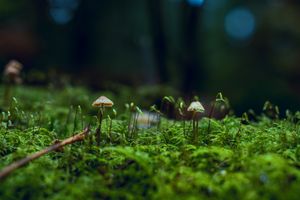
Mushroom Agaricus bisporus — edible saprotrophic fungus |
Bread Mould Rhizopus stolonifer — common household decomposer |
Yeast Saccharomyces cerevisiae — used in baking and fermentation |

Penicillium Penicillium notatum — source of penicillin antibiotic |
5. Comparison: Monera, Protista and Fungi
| Feature | Monera | Protista | Fungi |
|---|---|---|---|
| Cell type | Prokaryotic | Eukaryotic | Eukaryotic |
| Organisation | Unicellular | Unicellular | Mostly multicellular |
| Cell wall | Peptidoglycan | Variable / absent | Chitin |
| Nutrition | Auto / Heterotrophic | Auto / Heterotrophic / Both | Absorptive heterotrophic |
| Chlorophyll | Some have (Cyanobacteria) | Some have (algae, Euglena) | Absent |
| Examples | Bacteria, Cyanobacteria | Amoeba, Euglena | Mushroom, Yeast, Penicillium |
6. Watch and Learn
The following videos explain Kingdom Fungi and its role in nature. Click on a thumbnail to watch.


Things to remember title
Things to Remember
- Fungi are eukaryotic — they have a membrane-bound nucleus.
- The cell wall of fungi is made of chitin — not cellulose like plants.
- Fungi are heterotrophic by absorption — they cannot photosynthesise.
- Most fungi are multicellular; yeast (Saccharomyces cerevisiae) is unicellular.
- Body is made of thread-like hyphae; a collection of hyphae is called mycelium.
- Three nutrition types: saprotrophic (dead matter), parasitic (living host), symbiotic (mutual benefit).
- Penicillin antibiotic is obtained from Penicillium notatum.
- Yeast is used in baking bread and brewing through fermentation.
- Fungi reproduce primarily by producing spores.
© 2021 Saralmind. All Rights Reserved.
 Login with google