

Simple Machine: Introduction
Subject: Science and Technology

Overview
A simple machine makes work easier by multiplying force, changing direction, or increasing speed. Learn the key terms load, effort, mechanical advantage (MA = Load/Effort), velocity ratio (VR = effort distance/load distance), and efficiency (MA/VR x 100%) which apply to all six types of simple machines: lever, pulley, inclined plane, wedge, screw, and wheel and axle.
1. What is a Simple Machine?
A simple machine is a device that makes work easier by multiplying force, changing the direction of force, or increasing speed. Simple machines do not reduce the total amount of work done, but they allow a smaller force to be applied over a larger distance to lift or move a heavy load.
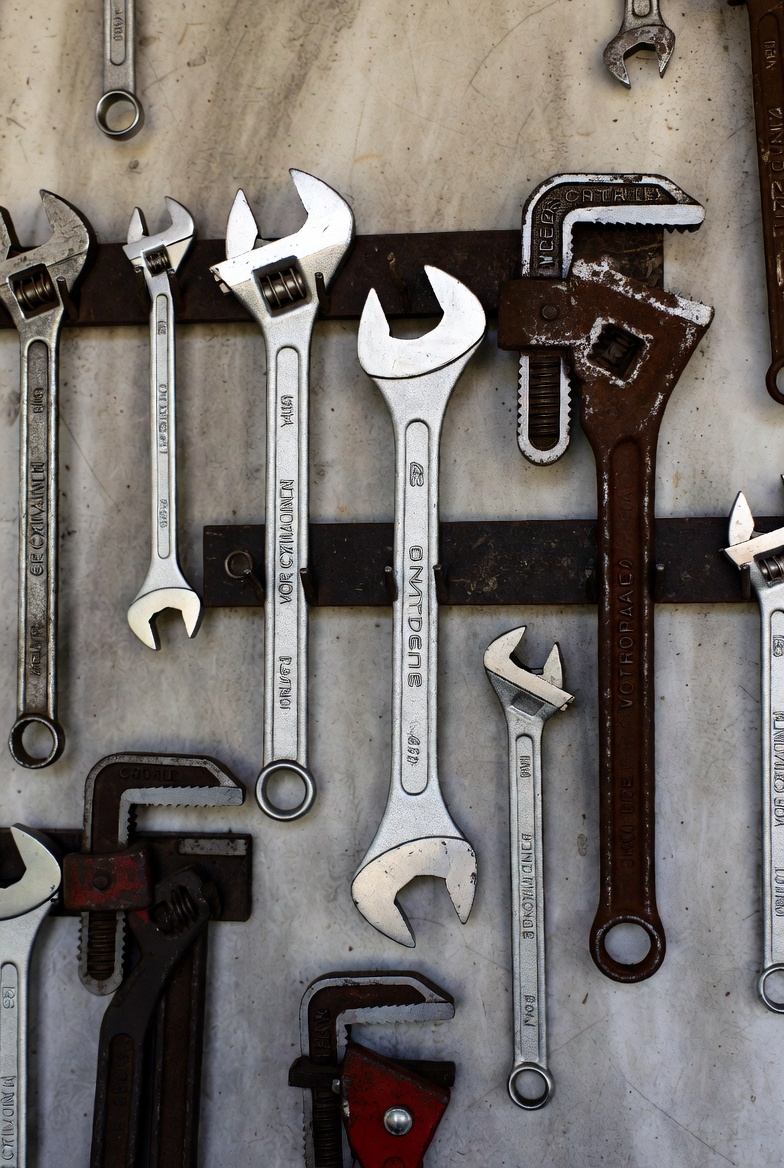
Wrenches, screwdrivers, and other workshop tools are all simple machines. Each one applies the principles of levers, wheel and axle, or screws to multiply the force a person can apply. Photo by Pixabay on Pexels.
Six types of simple machines: Lever, Pulley, Inclined Plane, Wedge, Screw, and Wheel and Axle
2. Key Terms
| Term | Definition |
|---|---|
| Load (L) | The weight or resistance the machine is used to overcome |
| Effort (E) | The force applied to the machine to overcome the load |
| Load distance (dL) | The distance through which the load moves |
| Effort distance (dE) | The distance through which the effort is applied |
3. Mechanical Advantage (MA)
The mechanical advantage is the ratio of the load to the effort. It tells us how many times the machine multiplies the effort force.
\[ MA = \frac{Load}{Effort} = \frac{L}{E} \]
- MA > 1: the machine multiplies force
- MA = 1: no force multiplication (only direction change)
- MA < 1: the machine multiplies speed and distance instead
4. Velocity Ratio (VR)
The velocity ratio is the ratio of the distance moved by the effort to the distance moved by the load in the same time.
\[ VR = \frac{\text{Distance moved by effort}}{\text{Distance moved by load}} = \frac{d_E}{d_L} \]
5. Efficiency
Efficiency is the percentage of energy input that is converted into useful work output. Machines always have efficiency below 100% because some energy is lost to friction, heat, and sound.
\[ \text{Efficiency} (\eta) = \frac{\text{Work output}}{\text{Work input}} \times 100\% \]
\[ \eta = \frac{MA}{VR} \times 100\% \]
- Work output = Load x Load distance
- Work input = Effort x Effort distance
6. Watch and Learn
The following videos explain simple machines, mechanical advantage, and efficiency. Click on a thumbnail to watch.


Things to remember title
Things to Remember
- A simple machine makes work easier by multiplying force, changing direction of force, or increasing speed.
- Six types of simple machines: lever, pulley, inclined plane, wedge, screw, wheel and axle.
- Load = weight/resistance to overcome. Effort = force applied to machine.
- Mechanical Advantage (MA) = Load / Effort. MA > 1 means force is multiplied.
- Velocity Ratio (VR) = effort distance / load distance.
- Efficiency (\(\eta\)) = (MA / VR) x 100% = (Work output / Work input) x 100%.
- Efficiency is always less than 100% in practice due to friction.
- Work output = Load x load distance. Work input = Effort x effort distance.
© 2021 Saralmind. All Rights Reserved.
 Login with google